Building Inference-Native Infrastructure for the Next Generation of AI
Nov 12, 2026 · 5 min read
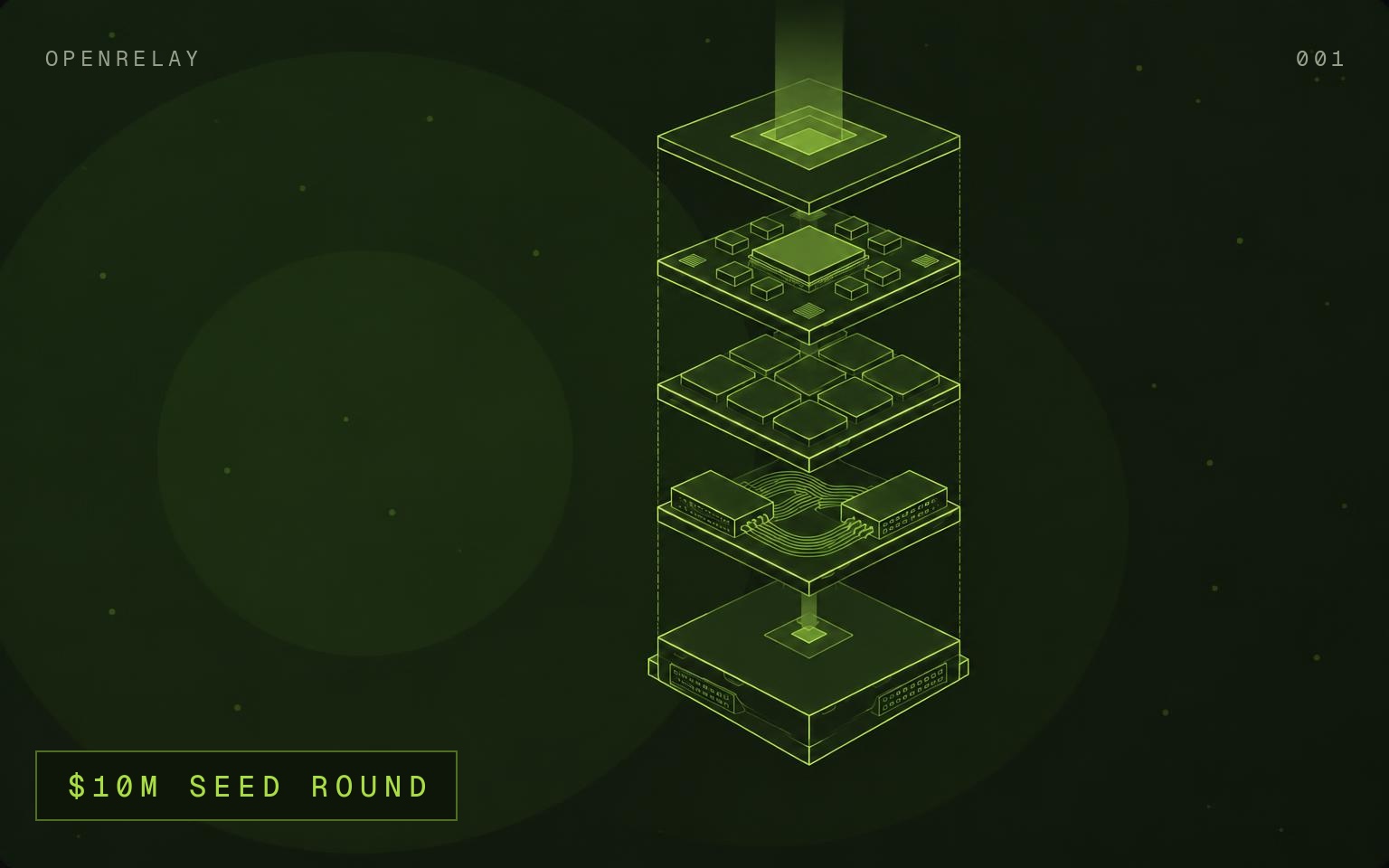
Following Y Combinator's Summer 2026 batch, we're announcing a $10 million seed round led by Uncork Capital, with participation from Eniac Ventures and Standard Capital, to expand OpenRelay's Inference Delivery Network and bring sophisticated AI infrastructure within reach of more builders.
We believe inference deserves infrastructure of its own.
Today's AI infrastructure has largely evolved from cloud computing architectures designed for a different era. Traditional cloud providers and newer GPU clouds have invested enormously in compute capacity. But much of the market still follows a familiar model. Give customers large blocks of computing resources and let them figure out how best to use them and, for inference, that model doesn't quite fit.
A robotics company deploying autonomous systems across multiple cities has very different infrastructure needs from an AI application processing millions of asynchronous requests. A developer building a real-time voice assistant needs something different from a company running large-scale batch inference.
Yet customers are often left dealing with the same constraints. Fixed hardware configurations, limited geographic flexibility, complicated infrastructure management, and pricing models that don't always reflect how their applications actually work.
The challenge isn't simply finding more GPUs, it's making the right compute available in the right place, at the right time, with the right performance and economics. And doing that takes more than access to hardware. It requires a new way to orchestrate it.
Unlocking the next generation of AI applications
We believe some of the most important AI applications have yet to be built. The next generation of AI won't be confined to a handful of large model developers or technology companies with enormous infrastructure budgets. Instead, it'll be built by startups, researchers, enterprises, robotics companies, and developers working on problems we can barely imagine today. And these builders need access to infrastructure that fits their applications, rather than forcing their applications to fit the infrastructure available to them.
As autonomous machines become more capable, they'll need to process information, make decisions, and interact with the physical world in real time. Where compute runs, how quickly it responds, and how reliably it performs will all become increasingly important.
The next generation of AI agents will have very different needs. They could execute thousands of inference operations as they take on more complex tasks, with costs and infrastructure requirements that look nothing like those of today's chat applications. We believe infrastructure should make these applications possible, not get in the way of bringing them to market. That's the opportunity we're building toward.
Introducing the Inference Delivery Network
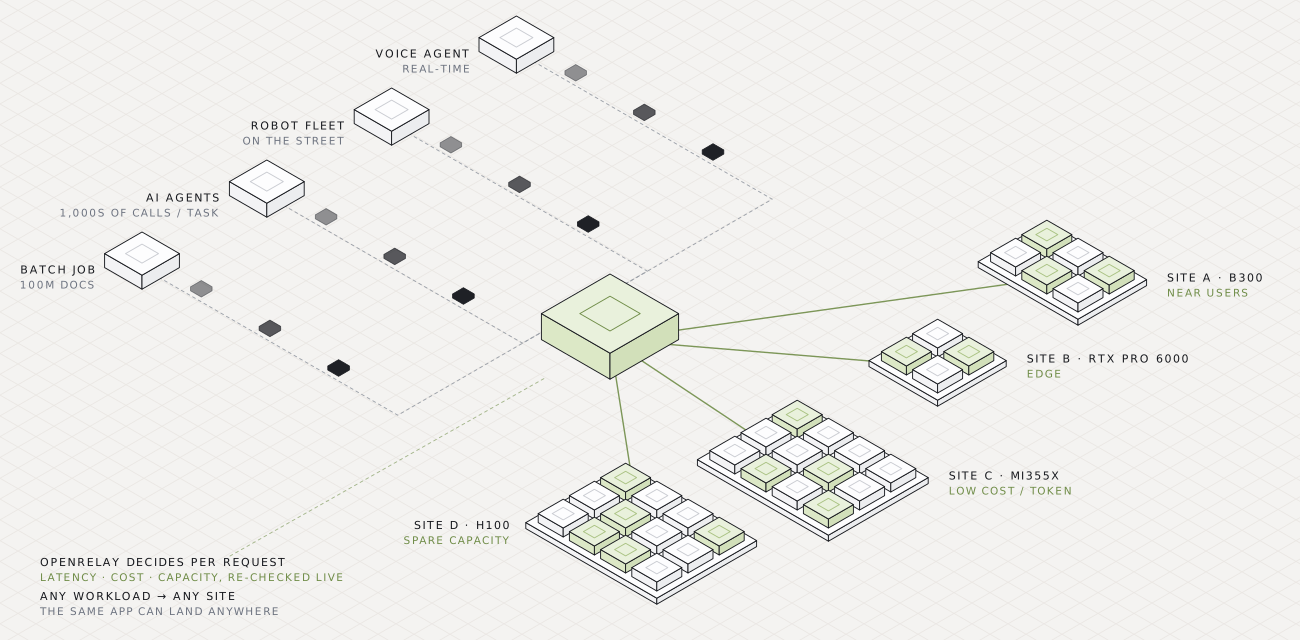
At OpenRelay, we're building infrastructure native to inference. Rather than simply selling access to compute, we're building infrastructure that adapts to the needs of the applications running on it.
That means optimizing for latency when milliseconds matter. Prioritizing throughput and cost when efficiency is the priority. Bringing compute closer to users and devices when location matters. And making sure applications have the reliability and flexibility they need to operate in the real world.
At the center of our approach is the Inference Delivery Network (IDN), a distributed network of compute infrastructure connected through proprietary orchestration software. Much as content delivery networks transformed how the internet delivers content, we believe inference delivery networks can transform how AI applications access and consume compute.
Our approach brings together two fundamental capabilities.
- Distributed, heterogeneous compute infrastructure. Rather than relying exclusively on massive, centralized data centers, we're building a distributed network of smaller compute deployments across multiple locations. This allows us to bring capacity closer to where it's needed, support different hardware architectures, and expand infrastructure more flexibly.
- A unified software orchestration layer. Our proprietary hardware abstraction and orchestration software connects these distributed resources, allowing them to operate as a unified infrastructure environment. Instead of requiring developers to manage individual machines, locations, and hardware configurations, OpenRelay can optimize infrastructure around the requirements of their workloads.
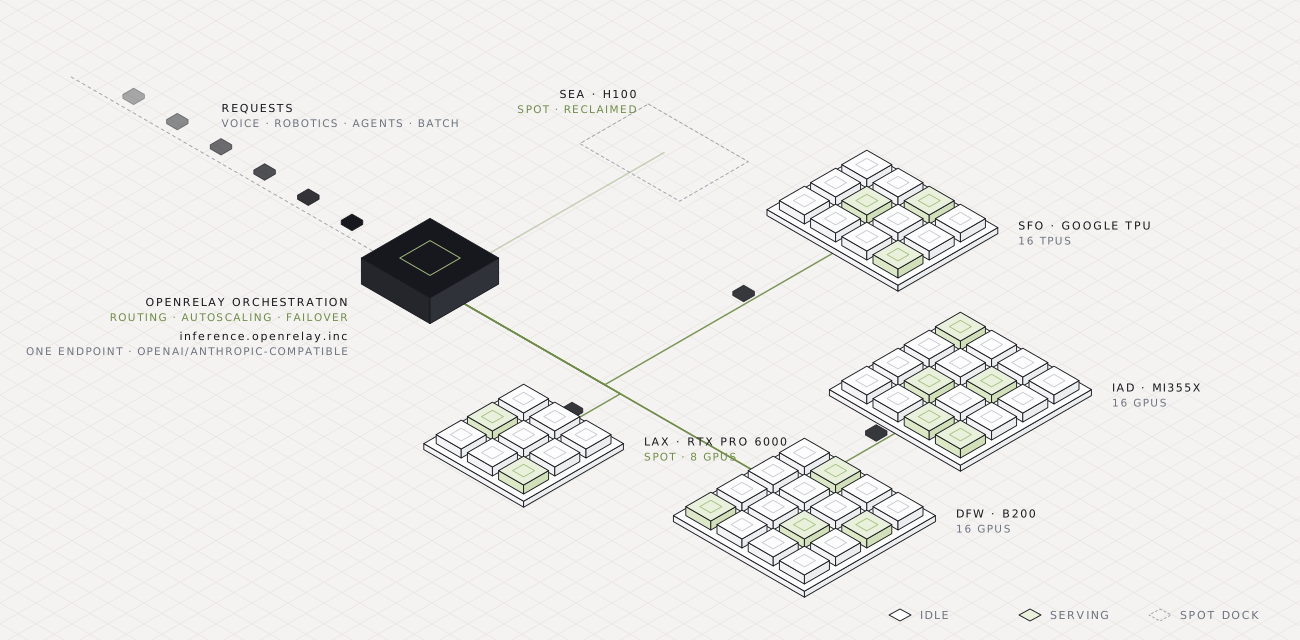
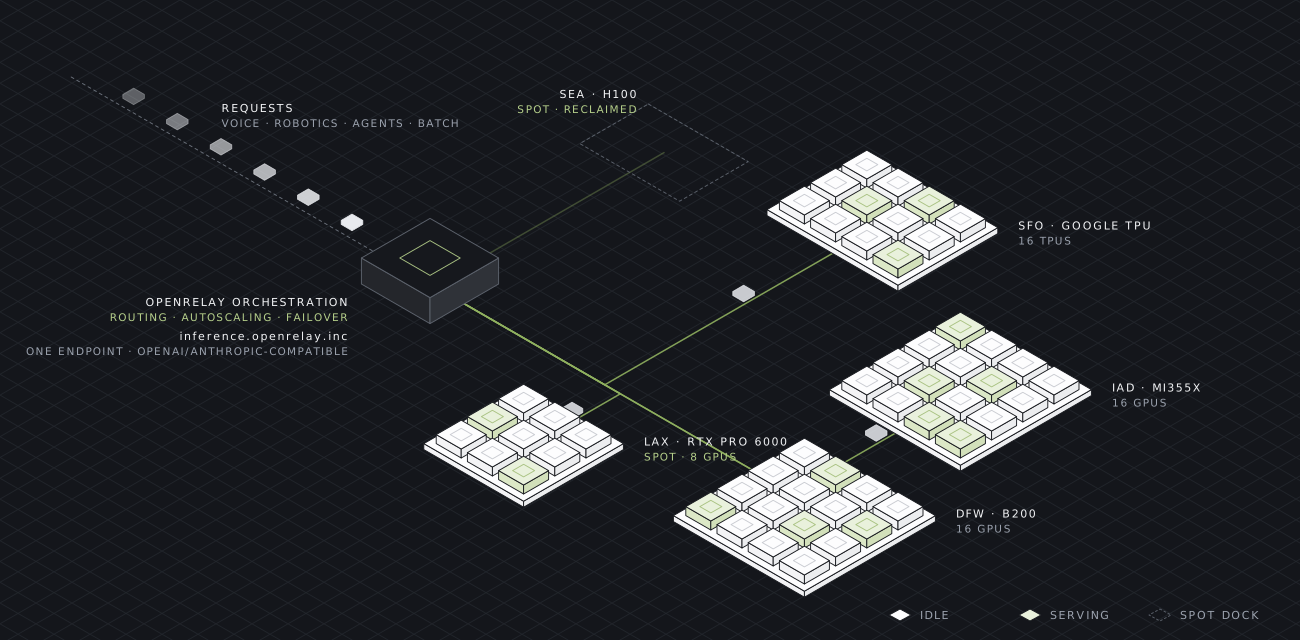
We believe the advantage comes from combining these two capabilities. Access to compute alone doesn't solve the problem, and software alone can't create capacity where it doesn't exist. By bringing physical infrastructure and orchestration together, we can continuously optimize how workloads run, improving performance, reliability, and economics without asking developers to manage that complexity themselves.
The result is a simpler way for developers to access increasingly sophisticated infrastructure without having to build and manage it themselves.
And we're already seeing what this approach can deliver. In less than five months since founding OpenRelay in June 2026, we've expanded to over 20 compute sites, over 5T tokens processed per month, and grown to over $10 million in annualized revenue run rate. We're still early, but the speed of that progress reflects the demand we're seeing for infrastructure built specifically for inference.
Vertically integrated, from the rack to the API
Traditional inference providers rely on third-party compute capacity and focus primarily on the software layer. We're building a vertically integrated inference network, combining our own infrastructure deployments with third-party capacity and designing the pieces to work as one system. That includes high-performance storage right next to the GPUs, high-speed networking between GPUs, and our own custom inference engine.
Together they let a model go from a full cold start to serving traffic in seconds, not minutes. That means we can scale capacity with real demand instead of keeping idle GPUs warm, place each model on the hardware that serves it best, and fix problems at the layer where they start instead of three vendors away. The result is lower latency, higher reliability, and better economics, passed on to the developers building with us.
What's next for OpenRelay
Today, we're announcing $10 million in funding, led by Uncork Capital, to accelerate that vision. We're thrilled to have Amy Saper and the team at Uncork as partners. They share our conviction that AI infrastructure is entering a new era, and we're excited to have them alongside us as we build for it.
We're expanding our Inference Delivery Network, deploying more distributed compute capacity, supporting an increasingly diverse range of hardware, and continuing to improve the orchestration software that brings it all together. We're also growing our team and opening an office in San Francisco, putting us right at the center of one of the world's most exciting communities of AI builders. We're bringing together people who want to rethink how AI infrastructure is built, deployed, and consumed.
We're still early in the evolution of AI inference, and while the applications, hardware, and infrastructure needs of the next decade will look very different from those of today, one thing is already clear. The future of AI will take more than bigger data centers and more GPUs. It'll take infrastructure that can adapt to an increasingly diverse world of models, applications, and computing environments.
If you're building an AI application that isn't well served by today's clouds, we'd love to talk. And if you're excited about building the next generation of AI infrastructure, we're hiring.
About OpenRelay
OpenRelay is building vertically integrated, inference-native infrastructure for the next generation of AI applications, combining distributed compute infrastructure with proprietary orchestration software through its Inference Delivery Network (IDN). By optimizing compute for the performance, cost, latency, and reliability needs of different workloads, OpenRelay makes sophisticated AI infrastructure accessible to more developers and companies without the complexity of managing it themselves.
Learn more at openrelay.inc